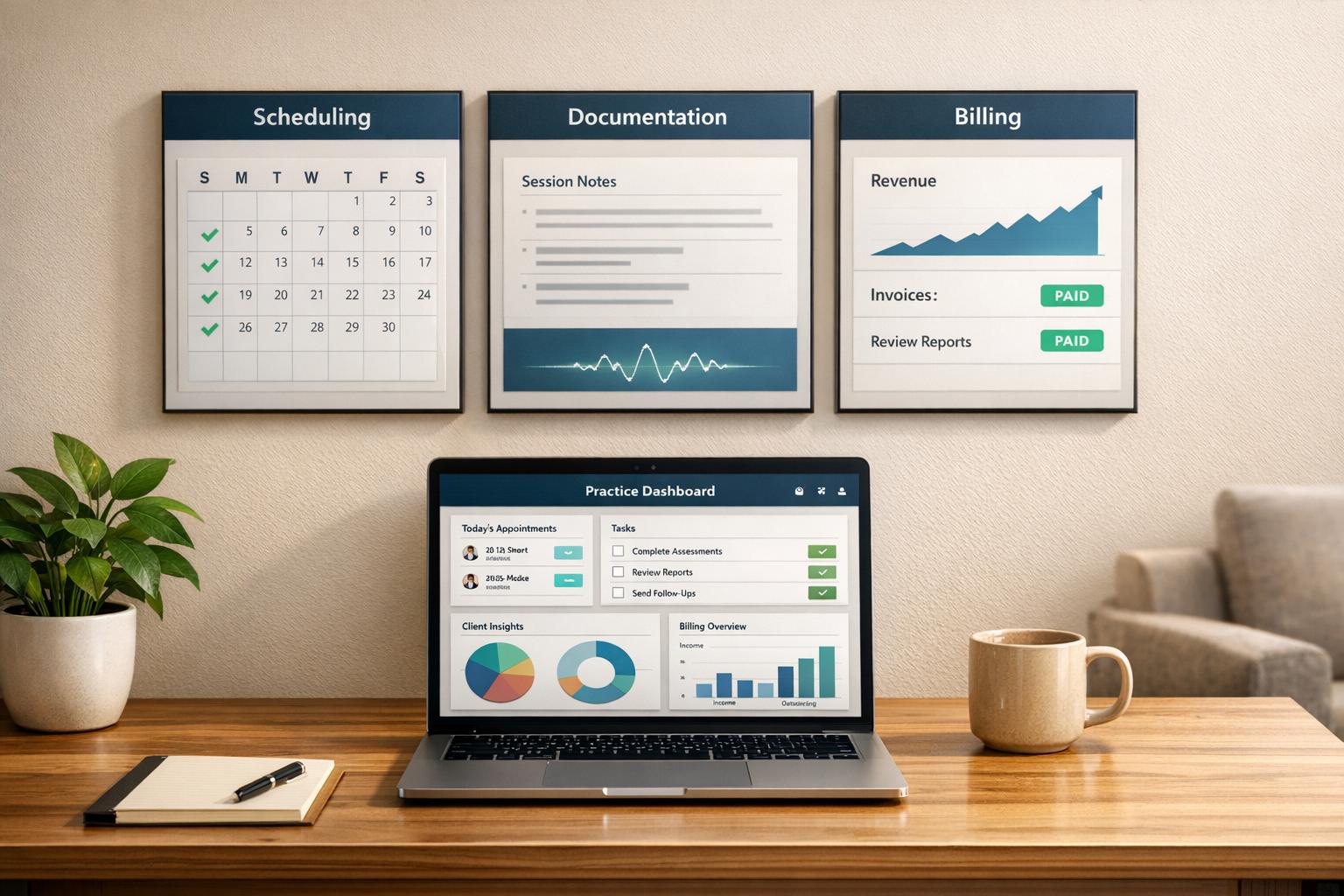
Profitability in a therapy practice isn’t just about seeing more clients – it’s about working smarter. Here’s what you need to know:
- Maximize Utilization: Boost therapist schedules to 80–85% capacity to increase revenue without unnecessary costs.
- Offer High-Value Services: Shift to higher-paying services like couples therapy or group sessions to improve income per session.
- Tiered Pricing: Introduce Basic, Standard, and Premium packages to cater to different client budgets and increase revenue.
- Automate Admin Tasks: Use tools like voice-to-text transcription and automated reminders to save time and reduce no-shows.
- Track Payments: Follow up on unpaid claims and fix billing errors to avoid losing thousands annually.
- Improve Client Retention: Use tools to track progress and keep clients engaged, reducing costly dropouts.
- Reduce No-Shows: Smart reminders can cut missed appointments by 50%, saving tens of thousands yearly.
- Streamline Supervision: Simplify compliance tracking to avoid lost claims and retain pre-licensed staff.
- Monitor Platform Fees: Track and negotiate fees to prevent unnecessary expenses and improve profit margins.
- Scale Efficiently: Focus on increasing revenue without proportional cost increases by leveraging technology and optimizing resources.
Key Insight: Small changes – like reducing no-shows, improving retention, and automating admin tasks – can significantly boost your bottom line without requiring more hours or staff.
10 Proven Strategies to Boost Therapy Practice Profitability
1. Increase Therapist Utilization Rates
Revenue Impact
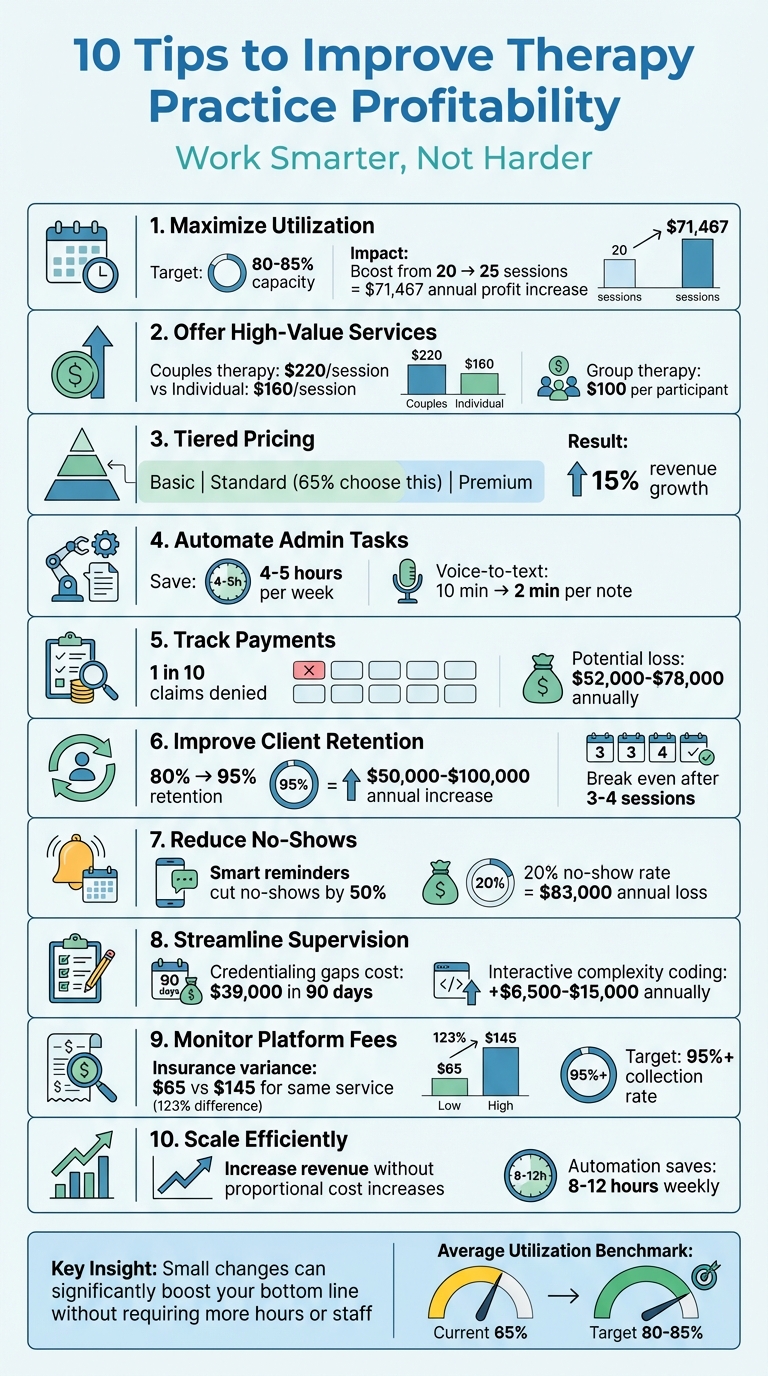
Utilization rate tracks how many sessions therapists complete compared to their weekly capacity. By 2026, the average therapist utilization hovers around 65%, but practices aiming for higher profitability should aim for 80–85%. Here’s why that matters: each non-billable hour drains about $75,000 annually in salary expenses.
Boosting a clinician’s weekly sessions from 20 to 25 can transform a group practice owner’s annual profit from $3,904 to $71,467. Even a 10% increase in utilization can add tens of thousands of dollars in monthly revenue since variable costs – typically 25% of revenue – don’t rise significantly with higher session counts. As Jordan Harris, Ph.D., from Private Practice Incubator, emphasizes:
The biggest factor in running a profitable practice is ensuring your clinicians have full caseloads.
Focusing on maximizing session capacity is a cornerstone for improving operations and financial outcomes.
Operational Efficiency
Before hiring more staff, take a close look at your team’s schedules. Many open slots are caused by administrative burdens. Therapists lose about 10 hours each week to tasks like scheduling, insurance verification, and documentation. However, automated tools for scheduling and billing can free up 4–5 hours per week, allowing therapists to handle more sessions without adding to overhead costs.
Strategic scheduling can also help maintain high utilization rates while avoiding burnout. By cutting down on cancellations and balancing workloads, practices can ensure therapists deliver consistent, quality care.
sbb-itb-ce1c1e8
How to Complete a Financial Review of Your Therapy Practice [UNDERSTAND REVENUE, EXPENSES & PROFIT]
2. Focus on High-Value Therapy Services
If you’re looking to boost profitability, focusing on high-value therapy services is a smart move. By strategically shifting your service offerings, you can improve revenue while optimizing your practice’s overall efficiency.
Revenue Impact
Not all therapy sessions are created equal when it comes to profit margins. For example, couples and family sessions typically bring in an average of $220 per session, compared to $160 for individual sessions. By shifting just 10% of your client volume toward these higher-value sessions, you could increase your blended revenue by about $6 per session.
Group therapy is another avenue with strong revenue potential. A single therapist can work with multiple clients at once, earning $100 per participant. For context, increasing group therapy sessions from 40 to 60 per month could add $6,000 in monthly revenue per therapist.
As SchedulingKit emphasizes:
The fastest way to grow a therapy practice is to stop trying to serve everyone. Therapists who specialize… fill their caseloads faster than generalists. – SchedulingKit
Specializing in areas like EMDR, trauma recovery, or postpartum anxiety not only allows therapists to maintain waitlists but also enables them to charge premium rates. Additionally, diversifying into workshops, online courses, or other digital resources can yield profit margins as high as 80%, far exceeding the typical 20% margin for traditional counseling.
Operational Efficiency
Focusing on high-value services does more than just increase revenue – it also simplifies operations.
A quarterly review of your service mix can help identify which offerings are most effective at covering overhead costs. For instance, group therapy, which operates at 55% utilization, provides an opportunity to maximize your staff’s capacity without adding extra administrative work. Similarly, offering extended 90-minute couples sessions allows for deeper therapeutic engagement while reducing the number of separate appointments to manage.
Defining a clear niche based on your expertise – such as the Gottman Method for couples, trauma-focused approaches, or adolescent therapy – can help attract clients who are specifically looking for your services. This not only builds trust with referral networks but also ensures fuller caseloads and higher per-session rates, eliminating the constant hustle to fill your calendar.
3. Use Tiered Pricing Strategies
Adjusting your pricing strategy to address different client needs can significantly boost profitability.
Revenue Impact
Offering Basic, Standard, and Premium packages allows you to cater to a wider range of budgets while increasing margins for premium services. For instance, shifting just 10% of your individual session volume (typically $160 per session) to couples therapy ($220 per session) can increase your blended average revenue per session by about $6. Over 100 sessions, this adds up to an extra $600. Similarly, raising the price of individual sessions by just $10 – from $160 to $170 – could generate an additional $1,000 in monthly revenue for every 100 sessions.
A real-world example comes from the Holistic Primary Care Clinic. In June 2025, they implemented tiered pricing with three packages: Basic ($150/month for two visits), Standard ($200/month for four visits and extended hours), and Premium ($300/month for unlimited visits and priority booking). The results were impressive – 65% of patients opted for the mid-tier Standard package, helping the clinic grow its revenue by over 15% in just one year. By offering a high-value Premium tier, they also enhanced the perceived value of the Standard option, making it the most appealing choice.
As Jordan Mather, CEO of Clinical Marketer, puts it:
Pricing is not about guessing what others will pay – it’s about valuing your time, expertise, and the transformation you provide.
Tiered pricing doesn’t just improve revenue; it also brings operational benefits.
Operational Efficiency
Creating three distinct service levels tailored to different client needs and budgets simplifies your practice’s operations. This approach avoids overwhelming clients with too many choices and ensures clarity. The key is to structure each tier around unique outcomes rather than simply offering "more or less" of the same service.
For example:
- Premium: Weekly sessions, priority scheduling, and unlimited messaging between appointments.
- Standard: Bi-weekly sessions with limited messaging support.
- Basic: Monthly sessions plus access to digital resources.
Each tier should be profitable – don’t use the entry-level option as a loss leader. This strategy not only enhances operational efficiency but also creates predictable monthly recurring revenue, providing stability compared to the ups and downs of pay-per-session models.
4. Use Voice-to-Text Transcription for Session Notes
Voice-to-text transcription can dramatically cut down the time spent on documentation, which means more time for client care and a noticeable impact on your revenue.
Revenue Impact
AI-driven transcription tools can reduce the time spent on session notes from 10 minutes to less than 2 minutes. According to data, 31% of therapists use this saved time to see additional clients, effectively increasing their session capacity. Over a week, this can free up more than 5 hours that can be redirected toward client care.
Operational Efficiency
Dictating notes immediately after sessions ensures details are fresh and eliminates the end-of-day documentation backlog. This practice can save providers anywhere from 5 to 10 hours each week. Features like punctuation commands and custom dictionaries enhance transcription accuracy, but it’s always a good idea to review notes for minor errors before finalizing.
Amber McKinney, a Licensed Clinical Social Worker, highlights the benefits:
For anyone hesitant: this is a lifesaver. It will change your life, and you have more time to be present with your patients.
Cost Savings
Traditional medical transcription services can cost between $1.10 and $3.25 per minute in 2024. On top of that, manual note-taking errors might cost a clinician around $4,000 annually, not to mention the risk of HIPAA violations, which can lead to settlements exceeding $88,000. Reducing administrative burdens also helps combat clinician burnout, which costs practices about $9,000 per clinician in turnover expenses and contributes to the $4.6 billion annual cost of healthcare burnout.
Client Retention Improvements
Less time spent on documentation means therapists can focus more on building strong relationships with clients. This personalized attention can lead to better engagement and a reduction in client no-show rates by up to 30%. By prioritizing care, therapists not only enhance client satisfaction but also improve overall retention rates.
5. Improve Payment Tracking and Collections
Keeping track of payments isn’t just about submitting claims – it’s about ensuring every dollar you’re owed actually makes it into your account. Many practices mistakenly think a clearinghouse "Accepted" status guarantees payment, but it only confirms the claim’s format was correct. Claims can sit in "silent suspension" or "in-process" queues unless someone actively follows up on them.
Revenue Impact
Poor tracking can lead to major revenue loss. Did you know nearly 1 in 10 insurance claims are denied? Many of these denials stem from avoidable mistakes. For a practice with a 10–15% denial rate, failing to address these issues could mean losing $52,000 to $78,000 annually. Even small coding errors can pile up. For instance, using CPT 90834 instead of 90837 for longer sessions or billing CPT 90853 per group instead of per patient could cost an individual practice $8,000–$12,000 or add up to $31,200 annually for group practices. Missing add-on codes, like CPT 90785 for interactive complexity, is another way revenue can slip through the cracks.
Operational Efficiency
To stay on top of claims, adopt a "30-Day Rule" – manually address any claim that’s been unpaid for more than 45 days. Most clean claims should be processed within 14 to 30 days.
"Aged A/R does not age into payment. It ages into write-offs." – Sirius Solutions Global
Automating claim scrubbing before submission can catch common errors, like missing CPT codes, incorrect NPI numbers, or mismatched demographics, boosting first-pass acceptance rates . Additionally, verifying insurance eligibility 48 hours before appointments helps prevent front-end denials and reduces the chances of surprise bills, which can frustrate clients. Tools like Voice CRM‘s payment tracking feature allow you to monitor key metrics – such as Days in Accounts Receivable and Net Collection Rates – to identify where payments are getting delayed . These strategies help resolve claims faster and minimize revenue loss.
Cost Savings
Streamlining collections doesn’t just increase revenue – it also reduces costs. Outsourcing therapy billing typically costs 5–9% of collections, while maintaining an in-house billing team can run 12–14% when you factor in salaries, benefits, and training. Automating tasks can save practitioners 4–5 hours of unpaid work each week.
"Success isn’t about the software you use; it is about the rigorous, consistent follow-through that ensures every dollar you earn makes it to your bank account." – TherapyPM
Using auto-pay features to charge stored credit cards on the same day as sessions eliminates the hassle of manual invoicing and reduces missed payments. This approach also cuts down on the time and expense of creating, sending, and chasing monthly invoices.
Client Retention Improvements
Clear payment processes don’t just boost revenue – they build trust. Transparent billing practices and upfront insurance verification ensure clients aren’t caught off guard by unexpected charges . When clients know what they owe before their appointment, they’re less likely to feel frustrated or blindsided, which strengthens their loyalty to your practice. Clear communication about payment expectations fosters a professional relationship that supports long-term engagement.
6. Improve Client Retention with Mood and Thematic Tagging
Tracking client progress isn’t just good clinical practice – it’s also a smart financial move. Most therapy practices lose money on the first session and typically don’t break even until after the third or fourth session. This means every client who leaves early directly impacts your bottom line.
Revenue Impact
Using mood and thematic tagging to improve client retention doesn’t just enhance care – it also makes financial sense. Better retention reduces the cost of acquiring new clients and ensures a steady revenue stream, so you’re not constantly scrambling to replace clients who drop out. It’s like fixing a “leaky bucket” – when clients stay longer, you spend less on marketing and more time focusing on care.
"Retention isn’t just a clinical metric – it’s a financial lever and a growth strategy." – Therapy Flow
Operational Efficiency
Voice CRM’s tagging tools allow you to organize clients by themes like anxiety, trauma, or relationship challenges. This saves up to 90% of the time you’d otherwise spend on manual tracking, letting you focus on providing quality therapy. Plus, the data helps pinpoint when clients are most likely to drop out – often after two or three sessions – so you can step in and address issues before they leave. This streamlined approach not only saves time but also strengthens client loyalty.
Client Retention Improvements
Clients are more likely to stick with therapy when they see clear evidence of their progress. By tracking mood and themes across sessions, you can show clients measurable improvements, reinforcing their commitment to the process. This personalized attention makes clients feel understood and valued, rather than treated with a one-size-fits-all approach. Interestingly, about 25% of therapists face retention challenges due to gaps in interpersonal skills. Thematic tracking can highlight these issues early, giving you the chance to address them during supervision. Fixing small problems – like struggles with building rapport – can prevent them from becoming reasons for clients to leave.
7. Cut No-Shows with Smart Reminders
Missed appointments don’t just waste time – they take a serious toll on revenue. Imagine a practice with 20 daily appointments at $80 per session. A 20% no-show rate could lead to losses of over $83,000 per year.
Revenue Impact
Smart reminders can make a huge difference in reducing the financial loss caused by no-shows. These missed appointments don’t just mean lost fees – they leave your calendar with empty slots that could’ve been filled by new clients. With no-show rates typically ranging from 10–30%, automated reminders have been shown to cut these rates by more than 50%. For example, practices without reminders often face a 23.1% no-show rate, while those using automated systems can bring that number down to 17.3%. Fewer no-shows translate to more billable hours – without needing to spend extra on marketing.
Operational Efficiency
Relying on manual reminder calls just isn’t feasible for a growing practice. That’s where Voice CRM’s smart reminder system steps in. It automates the process, sending timely notifications – usually 48 hours and again 1–2 hours before the session – via multiple channels. With SMS messages boasting a 98% open rate compared to email’s 20%, these reminders ensure appointments stay top-of-mind. Plus, one-tap rescheduling links make it easier for clients to adjust their plans, reducing last-minute cancellations.
Cost Savings
Automation doesn’t just save time – it prevents wasted resources. Voice CRM’s system helps eliminate administrative tasks and avoids costly downtime caused by empty appointment slots. Its automated waitlist feature is another game-changer, notifying waitlisted clients instantly when a cancellation occurs. This recovers 50–70% of last-minute openings without requiring manual effort. Considering that forgetfulness accounts for 40–50% of missed appointments, automated reminders are a simple yet effective way to boost productivity and streamline scheduling.
8. Simplify Supervision and Compliance Tracking
Operational Efficiency
Managing supervision and compliance can be a headache, especially when relying on outdated paper trails for co-sign requirements. Voice CRM changes the game by integrating co-sign workflows and offering standardized templates such as SOAP, DAP, or BIRP. These tools simplify documentation for pre-licensed clinicians, cutting down on time-consuming tasks and reducing administrative stress. The result? A smoother process that not only saves time but also boosts revenue potential. Less time spent on paperwork means more focus on what truly matters – providing care and growing your practice.
Revenue Impact
Fully licensed clinicians bring in more appointments and, by extension, more revenue. But credentialing gaps can be costly, potentially leading to $39,000 in lost claims over just 90 days. Voice CRM helps you stay ahead by tracking licensure progress and credentialing timelines, ensuring delays don’t eat into your bottom line. Rachel Ledbetter, CEO and Co-Founder of Motivo Health, puts it perfectly:
"Supervision isn’t a cost of compliance. It’s a differentiator in a competitive labor market where pre-licensed clinicians have choices about where they train."
Additionally, accurate coding for interactive complexity can add $25–$30 per session, translating to $6,500–$15,000 in annual revenue. Voice CRM also uses automated time-validation to flag missing session timestamps before claims are submitted, reducing the chance of denials that cost $30–$60 per session. By staying on top of licensure and ensuring proper coding, your practice can maximize every session’s financial value.
Cost Savings
Streamlined compliance doesn’t just boost revenue – it also slashes expenses tied to billing errors. For instance, incorrect NPI billing often results in permanent write-offs. Voice CRM minimizes these losses by ensuring claims are submitted correctly on the first try and lightening the administrative workload for supervisors. This level of efficiency is critical, especially when you consider that 54% of pre-licensed therapists leave the field before becoming fully licensed – often due to gaps in supervision programs. By addressing these structural issues, Voice CRM helps retain talent while reducing costly errors, ultimately strengthening your practice’s financial health.
9. Negotiate and Track Platform Fees
Cost Savings
Keeping platform fees in check – whether it’s for EHR subscriptions or telehealth licenses – is essential for improving net margins. For a typical group practice with a 70/30 clinician split, that 30% has to stretch to cover all overhead, including these fees. Surprisingly, many practices don’t track these expenses separately, which makes it harder to pinpoint where money is being wasted. To fix this, set up separate categories in your accounting software for "transaction fees" and "professional fees." This simple step can reveal areas where you can cut costs.
Revenue Impact
Platform fees can vary a lot, especially when it comes to insurance reimbursements. For example, one insurance plan might pay $65 per session (CPT 90837), while another pays $145 for the same service. That’s a staggering 123% difference for identical work! In states with telehealth parity laws, some practices still accept lower telehealth rates simply because they haven’t renegotiated their contracts. As Sirius Solutions Global explains:
Practices in parity states still accepting lower telehealth reimbursements because they never renegotiated contracts are leaving money on the table with every claim.
To avoid this, regularly review your payer mix and request updated fee schedules from insurance consultants. This helps you figure out which contracts to renegotiate – or even drop altogether. Ignoring these gaps could cost a small to mid-sized practice around $50,000 per year in lost revenue. Keeping a close eye on these fees is a small effort that can make a big difference.
Operational Efficiency
Using tools like Voice CRM can help you monitor platform performance by tracking metrics such as your net collection rate and clean claim rate. Ideally, your billing system should achieve a 95% or higher collection rate, and your clean claim rate should fall between 90% and 95% on the first submission. Practices with an 80% clean claim rate, however, could lose $52,000 to $78,000 annually, assuming 100 weekly sessions at a $100 average. Automating this tracking process can help you identify underperforming payers and decide which platforms are worth keeping and which ones are costing you more than they’re worth.
10. Grow Your Practice Without Increasing Overhead
This strategy zeroes in on scaling your practice – boosting revenue without the need for a proportional rise in expenses.
Revenue Impact
When you grow, revenue increases alongside expenses. Scaling, on the other hand, focuses on raising revenue while keeping costs steady. For example, hiring two more therapists might increase revenue by 25–33%, but the initial profitability often takes a hit due to onboarding expenses and higher overhead for the first 6–15 months. Instead, scaling involves making better use of your current resources to drive profits without adding extra fixed costs, much like optimizing session utilization.
Operational Efficiency
Mental health practice management software can be a game-changer here. By automating tasks like reminders, follow-ups, and billing through tools like Voice CRM, your practice can handle increased volume without needing to hire more administrative staff. These tools can also highlight underutilized hours in your therapists’ schedules, allowing you to maximize service dates without additional hires. As Cindy Trawinski, PsyD, puts it:
Scaling… means significantly increasing revenue without a proportional increase in costs.
In short, automation not only expands your practice’s capacity but also paves the way for significant savings.
Cost Savings
Before investing in marketing or new hires, use your software’s data to address retention challenges. Features like Auto Pay and insurance eligibility verification streamline payment processes, ensuring timely collections and reducing the need for manual tracking. Telehealth integration is another way to cut costs – it eliminates the need for more physical office space while giving you the ability to serve underserved populations. These steps help you grow efficiently while keeping overhead low.
Conclusion
Boosting profitability in your practice isn’t about putting in more hours – it’s about making smarter decisions with the resources you already have. By focusing on utilization rates, offering high-value services, refining your pricing, and automating time-consuming administrative tasks, you can position your practice for stronger financial health. As Traktion Accounting explains:
Profitability isn’t about overworking. It’s about designing your practice to support you, not just your clients.
Small operational changes can lead to big results. For example, enforcing no-show policies, fixing billing errors, and improving client retention can have a noticeable impact. Did you know that increasing client retention from 80% to 95% could add between $50,000 and $100,000 to a group practice’s annual revenue? Tools that automate reminders, payment tracking, and note-taking can save you 8–12 hours a week – time that can be redirected toward client care .
Once these efficiencies are in place, keeping a close eye on key performance metrics becomes essential. Regularly track figures like utilization rates, rebooking percentages, and days in accounts receivable. For instance, if your utilization rate is hovering at 65% instead of the target 80%, it’s time to dig deeper. Likewise, if clients aren’t rebooking after their third session, that’s a clear sign to work on retention strategies. After all, retention isn’t just good for your clients – it’s one of the most effective ways to grow your practice.
FAQs
What KPIs should I track weekly to improve profitability?
Keeping an eye on the right metrics can make a big difference in maintaining and improving your profitability. Here are some key areas to focus on:
- Client Retention Rates: Look at how many clients stick with therapy for at least eight sessions. This can give you insight into client satisfaction and the overall stability of your practice.
- Revenue and Expenses: Regularly review your income and costs. This helps you get a clear picture of your current profitability and spot any financial trends early.
- Billing Metrics: Stay on top of insurance-related numbers like eligibility checks, collection rates, and reimbursement rates. These are crucial for ensuring a steady cash flow.
- No-Show Rates: Keep track of cancellations or missed appointments. High no-show rates can disrupt your schedule and lead to unnecessary revenue loss.
How can I increase utilization to 80–85% without therapist burnout?
To increase utilization rates to 80–85% while avoiding burnout, prioritize effective time management and efficient operations. Leverage tools like automation, online booking systems, and electronic forms to cut down on administrative work. Establish clear scheduling policies, allowing rescheduling only for emergencies, and reduce no-shows with automated reminders. Additionally, verifying insurance ahead of appointments can save valuable time. These steps can help you manage your schedule better, lower stress, and maintain a healthier work-life balance.
How can I set tiered pricing without losing existing clients?
To roll out tiered pricing without alienating clients, focus on clear and honest communication about the changes and their advantages. Begin by introducing the new pricing structure to new clients or during contract renewals with existing customers. For long-time clients, consider keeping their current rates for a limited time, allowing them the flexibility to upgrade when they’re ready. Emphasize the value each tier provides, helping clients feel confident and supported in selecting the option that aligns with their needs.