
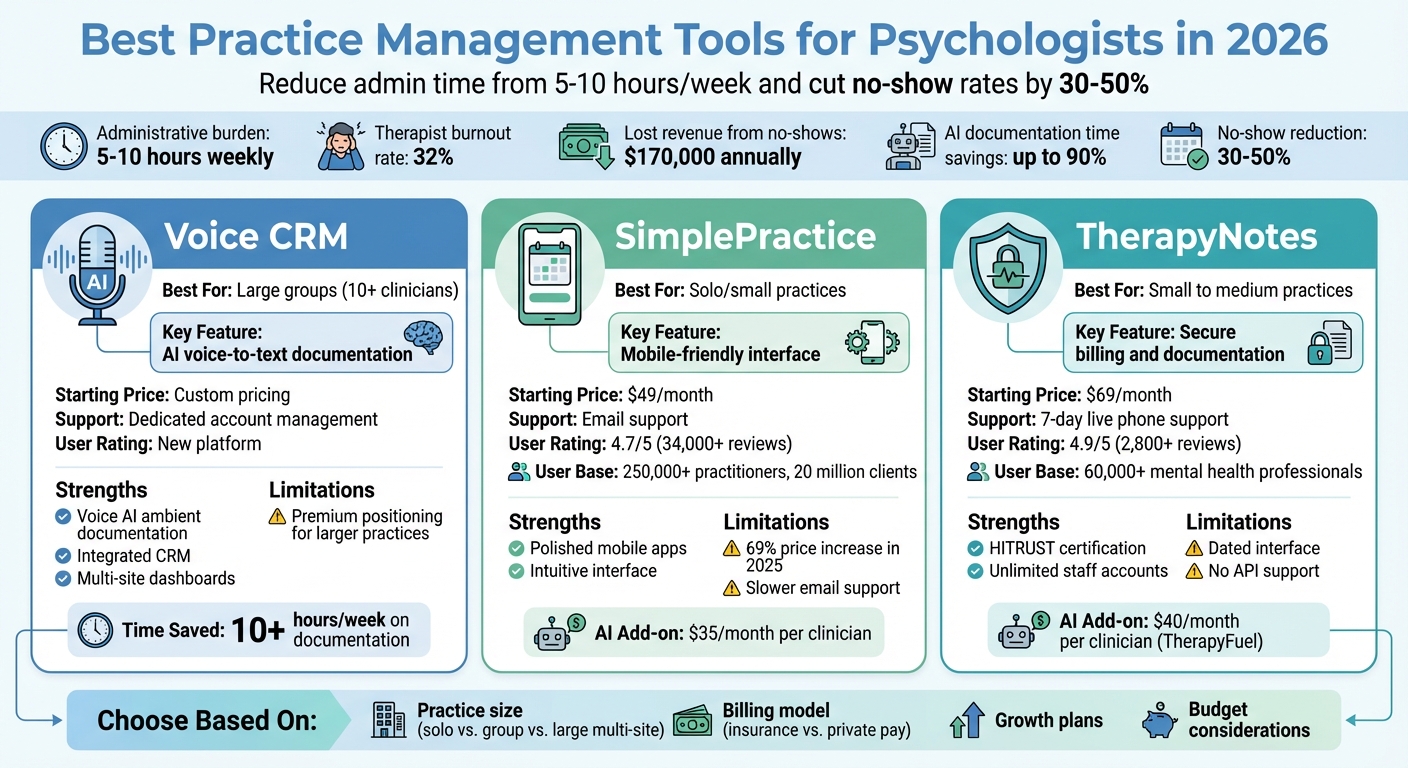
Psychologists spend 5–10 hours weekly on administrative tasks like scheduling, billing, and documentation. This workload contributes to burnout for 32% of therapists and results in lost revenue due to no-shows, averaging $170,000 annually for some practices. Modern tools now combine scheduling, billing, and documentation into single platforms, with AI reducing documentation time by up to 90% and cutting no-show rates by 30–50%.
Three standout tools in 2026 are:
- Voice CRM: AI-driven voice-to-text note generation, financial tracking, and supervision tools tailored for group practices.
- SimplePractice: User-friendly mobile design, secure billing, and voice-to-text note-taking for solo and small practices.
- TherapyNotes: Reliable clinical documentation and billing, with HITRUST-certified security for small to medium practices.
Choosing the right tool depends on your practice size, billing model, and growth plans.
Quick Comparison
| Feature | Voice CRM | SimplePractice | TherapyNotes |
|---|---|---|---|
| Best For | Large groups (10+ clinicians) | Solo/small practices | Small to medium practices |
| Key Feature | AI voice-to-text documentation | Mobile-friendly interface | Secure billing and documentation |
| Starting Price | Custom pricing | $49/month | $69/month |
| Support | Dedicated account management | Email support | 7-day live phone support |
Each tool addresses different needs, from AI-powered efficiency to robust billing and security. Pick one that aligns with your practice goals.
Practice Management Software Comparison for Psychologists 2026
SimplePractice Vs TherapyNotes (2026) | Which Practice Management Software Is Better?
sbb-itb-ce1c1e8
1. Voice CRM – Therapy notes that write themselves
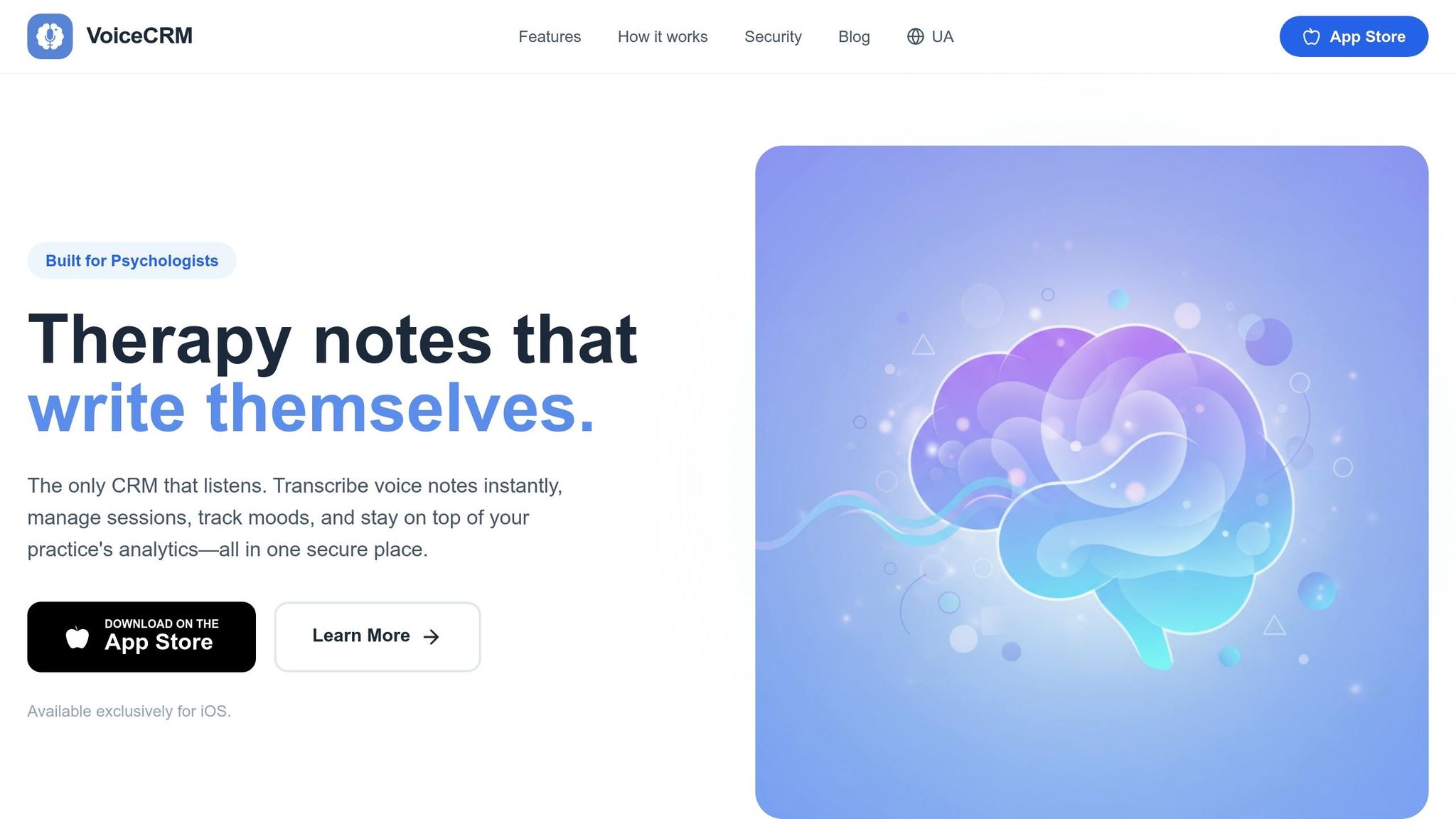
Voice CRM, built specifically for iOS, simplifies practice management by turning voice recordings into clinical notes. Instead of spending extra hours typing up session details, psychologists can record summaries immediately after a session. The AI-driven transcription then formats these recordings into structured notes and links them directly to the client’s profile. This approach streamlines documentation and helps practitioners focus on their clients.
Voice-to-Text Integration
With its voice-to-text feature, Voice CRM can save psychologists over 10 hours a week on documentation tasks. A single tap starts the recording, allowing practitioners to capture key insights right after each session. Features like thematic tagging and mood tracking transform these voice recordings into organized, searchable data, making it easier to plan treatments and analyze practice trends.
HIPAA Compliance
Voice CRM prioritizes security with end-to-end encryption for all data, whether it’s being transmitted or stored. Built to meet healthcare-grade standards, it ensures that only the practitioner can access client information. This level of security helps maintain confidentiality and addresses concerns about handling sensitive voice-recorded clinical data.
Billing and Financial Management
The platform also includes tools for managing finances. A financial dashboard tracks payments, outstanding balances, and compares income with expenses. Automated reminders help clinicians stay on top of logging notes and payments, reducing the need for manual updates and ensuring financial records are always accurate.
Supervision Tracking
Voice CRM caters to the needs of training psychologists with its supervision tracking feature. It allows users to manage cases tied to specific clients or general practice questions. Additionally, the system tracks supervision costs alongside practice income, making it particularly helpful for psychology students and interns navigating their early careers.
2. SimplePractice
SimplePractice has earned the trust of over 250,000 practitioners and serves 20 million clients as of 2026. It was named the #1 EHR Software of 2025 by TechRadar and boasts an impressive 4.7/5 star rating across major app stores. Many psychologists value its straightforward interface and mobile-first design, which feels like a breath of fresh air compared to older, more cumbersome EHR systems.
Voice-to-Text Integration
One standout feature of SimplePractice is its advanced voice-to-text capabilities. The AI-powered Note Taker transforms voice recordings or dictated summaries into structured clinical notes, supporting formats like SOAP, DAP, or BIRP – all while adhering to HIPAA standards. This optional add-on costs about $35 per month per clinician, offering a practical solution for streamlining documentation tasks.
HIPAA Compliance
SimplePractice prioritizes data security with HITRUST certification, a respected standard in the EHR industry. Practitioners receive a signed Business Associate Agreement (BAA) upon registration, and the platform encrypts all sensitive information, including session notes, secure messages, and billing details. To further safeguard accounts, two-factor authentication is mandatory.
As Katie Malinsky, LCSW-S, explains, "With SimplePractice, you’re hiring security professionals to make sure that information is managed with everything you need to be HIPAA-compliant".
Billing and Financial Management
The platform simplifies payments with its AutoPay feature, which automatically charges client credit, debit, FSA, or HSA cards after sessions. It also handles electronic insurance claims (CMS-1500) in real time and generates superbills for out-of-network providers. All billing documents are accessible through a HIPAA-compliant client portal. Payments are processed via Stripe at a rate of 2.95% plus $0.30 per transaction, while electronic claims incur a $0.25 fee each.
Dr. Donna Oriowo, LCSW, notes, "SimplePractice documentation can save you over $25,000 a year".
Supervision Tracking
For supervisors, the Plus plan ($99 per month) includes the ability to co-sign clinical notes and forms, with audit logs providing detailed records of user access to client files. This helps maintain compliance in supervised settings. However, for practices with more than 10 clinicians, the platform’s administrative tools can feel limited. It lacks features like formal organizational hierarchies and in-depth provider analytics, which larger practices may require.
These features highlight what makes SimplePractice stand out, setting the stage for a closer look at its pros and cons.
3. TherapyNotes
Since its launch in 2010, TherapyNotes has maintained a stellar 4.9/5 rating from over 2,800 reviews. The platform, which is ONC-certified, caters to practices that value structured clinical documentation and dependable insurance billing processes. While some users feel the interface could use a more modern update, many mental health professionals appreciate the platform’s comprehensive clinical tools and billing features.
Voice-to-Text Integration
TherapyNotes offers TherapyFuel, an AI-powered tool designed to convert voice recordings into structured clinical notes. This add-on is priced at $40 per clinician per month. TherapyFuel operates with a strong focus on privacy, processing all data securely within the TherapyNotes system rather than relying on external AI models. Additionally, TherapyNotes is one of the first AI platforms certified by HITRUST, ensuring strict protection of Protected Health Information (PHI) during AI-assisted documentation.
HIPAA Compliance
TherapyNotes prioritizes data security by employing FIPS 140-2 and TLS encryption. The system also includes two-factor authentication and role-based permissions, limiting staff access to only the necessary information. To meet HIPAA audit requirements, an activity log tracks nearly every action, linking each one to a specific user.
"TherapyNotes® software is HITRUST certified to demonstrate our risk management and security operations, as well as one of the first platforms to receive AI HITRUST certification", the company states.
As of February 16, 2026, TherapyNotes complies with updated federal regulations for managing "Part 2" substance use disorder records. With healthcare data breaches costing an average of over $10 million in 2026, these security measures are crucial for safeguarding sensitive information.
Billing and Financial Management
TherapyNotes streamlines billing by automatically queuing claims for submission once notes are completed. The platform supports Electronic Remittance Advice (ERA) auto-posting, which applies insurance payments and adjustments directly to patient accounts, eliminating the need for manual data entry. Practices can submit electronic claims for $0.14 each or choose an unlimited plan for $65 per month, which becomes cost-effective at around 465 claims.
Matthew Church, M.S., Mental Health Technology Editor at Choosing Therapy, explains: "The platform automatically generates CMS-1500 forms, flags unpaid or denied claims in the built-in to-do list, and allows clinicians to track claim status directly from the client record".
Real-time insurance eligibility checks, available at $0.14 per check, help reduce claim rejections by verifying coverage before appointments. The system also processes copays and self-pay balances through an integrated card-on-file feature, charging 3.1% + $0.30 per transaction. Clients can conveniently pay invoices via the HIPAA-compliant TherapyPortal. For its billing and payment features, the platform earned a 4 out of 5 star rating in 2026.
Supervision Tracking
TherapyNotes allows Practice Administrators to assign a "Supervisor" role to users, linking them to clinicians or interns. Supervisors have three permission levels, and the system automatically generates review tasks for notes completed by supervisees.
This system facilitates "incident-to" billing by enabling supervisors to co-sign notes, a key requirement for billing services under a supervisor’s credentials. Practices can configure billing settings at the staff or payer level, choosing to bill as the clinician, include both clinician and supervisor details, or bill solely under the supervisor. Beyond the $69 per month solo practitioner base rate, additional clinicians and supervisors cost $39 per month each. These features make TherapyNotes a flexible solution for managing clinical and administrative workflows.
Pros and Cons Comparison
This section breaks down the highlights and drawbacks of three platforms aimed at streamlining administrative tasks while maintaining security and operational efficiency.
SimplePractice stands out with its sleek design and mobile-friendly features. It has garnered a 4.7/5 rating from over 34,000 reviews for its clinician app. However, a steep 69% price hike in early 2025 raised concerns, and users have noted slower email support responses.
TherapyNotes shines with its HITRUST certification and top-notch customer service, including live phone support available every day of the week. With over 60,000 mental health professionals relying on the platform, it also offers unlimited non-clinical staff accounts at no extra cost. Despite these strengths, its interface feels dated, and the lack of API support for integrations may push some expanding practices to explore other options.
Voice CRM differentiates itself with an AI-driven approach, offering voice AI documentation that essentially "writes itself", a built-in CRM for tracking referrals, and real-time executive dashboards tailored for multi-site operations. It’s designed for growing groups with 10 or more clinicians, focusing on unified revenue cycle management and advanced operational needs. Pricing is customized based on the size and scope of the practice, reflecting its premium, enterprise-level positioning.
Here’s a quick comparison of the platforms:
| Feature | Voice CRM | SimplePractice | TherapyNotes |
|---|---|---|---|
| Best For | Growing groups (10+ clinicians) needing AI-native infrastructure for documentation efficiency and operational insights | Solo practitioners and small practices valuing modern UX and mobile-first design | Small to medium groups prioritizing clinical reliability and comprehensive billing tools |
| Key Strength | Voice AI ambient documentation, integrated CRM, multi-site dashboards | Polished mobile apps, intuitive interface, 200,000+ user base | HITRUST certification, 7-day phone support, unlimited staff accounts |
| Main Limitation | Premium positioning for larger practices | 69% price increase in 2025, slower email support | Less modern interface, lacks API support limiting integrations |
| Starting Price | Custom (enterprise-focused) | $49/month (Starter plan) | $69/month (Solo plan) |
| Support Quality | Dedicated account management | Email-based support | Live phone support 7 days/week |
| User Rating | New platform | 4.7/5 overall | 4.9/5 overall |
Choosing the right platform depends on your priorities – whether it’s cutting-edge AI features, a user-friendly mobile experience, or dependable support and clinical tools. Each platform offers a distinct set of benefits tailored to different practice needs.
Conclusion
Voice CRM emerges as a practical solution for therapy practices of all sizes, thanks to its AI-powered documentation and detailed financial analytics. Its voice-to-text functionality directly tackles a major pain point for therapists: the 5 to 10 hours per week typically spent on scheduling and billing. This administrative load is a contributing factor to the 32% burnout rate reported among therapists. By saving an estimated 15 to 20 minutes per session through AI-assisted documentation, Voice CRM allows practitioners to dedicate more time to clinical work.
For solo practitioners, Voice CRM is both affordable and easy to use. Its AI-driven tools significantly reduce the time spent on manual note-taking, freeing up hours each week. Additionally, its financial dashboard simplifies practice management by consolidating payments and outstanding balances into one system, eliminating the need to juggle multiple platforms.
Group practices benefit from Voice CRM’s scalability and robust billing features. The platform’s AI-native documentation and real-time financial analytics provide the operational insights needed for managing multi-site practices. Its supervision tracking tools are particularly useful in training environments, enabling supervisors to oversee cases and monitor supervision costs alongside practice income.
Insurance-based practices find value in Voice CRM’s automated reminders, which have been shown to reduce no-show rates by 30–50%. For private-pay practices, the platform’s centralized billing tools streamline payment and expense tracking, removing the need for separate spreadsheets or additional accounting software.
Modern practice management tools now integrate AI-assisted documentation that can reduce documentation time by up to 90%. Voice CRM fulfills this promise by converting voice recordings into structured clinical notes, complete with features like thematic tagging and mood tracking. This creates an organized, searchable database that supports effective treatment planning.
Deciding on the right tool depends on three key factors: the size of your practice, your revenue model (insurance or private pay), and your growth plans. Voice CRM offers scalable AI-driven solutions and integrated dashboards to meet these needs, whether you’re a solo practitioner seeking simplicity or a growing practice requiring advanced operational tools. Select a platform that aligns with your goals and addresses the evolving demands of therapy management.
FAQs
How accurate are AI-generated therapy notes from voice recordings?
AI-powered tools for generating therapy notes from voice recordings offer impressive accuracy, especially with advanced systems that support structured formats and adaptable capture modes. That said, a bit of editing might still be required to fine-tune the details and align the notes with professional standards.
How does Voice CRM protect HIPAA and sensitive client audio data?
Voice CRM protects sensitive client audio data and ensures HIPAA compliance by encrypting all voice recordings and transcripts in real time. With its multi-layered security approach, it minimizes the risk of data breaches, offering mental health professionals a secure and dependable way to handle confidential information.
What should I consider before switching my practice to Voice CRM?
Before moving to Voice CRM, check if it includes features designed specifically for mental health professionals. Look for tools like customizable forms, secure telehealth capabilities, and options for creating structured treatment plans. Make sure it adheres to HIPAA regulations and meets data security standards. It’s also important to verify that it integrates seamlessly with your existing workflows, such as scheduling and billing systems. Lastly, take time to read user reviews to gauge its ease of use, dependability, and whether it aligns with the needs of your practice.